
Martin Dronfield, Joint Shareholder & Director and Mark Buckton, Associate Director Employment & Skills, the Opergy Group of Companies
As we enter a new year, the UK energy sector is hurtling toward an unprecedented challenge: a fierce competition for skilled workers that will define the UK’s Net Zero success over the next 25 years.
The race to meet the UK’s legally binding net-zero ambitions has thrown the energy industry into rapidly accelerating transformation towards renewable and low carbon generation and created a demand for human capital that is surging across the energy industry.
This is happening at the same time as other industrial sectors are also expanding, and simultaneously, our workforce is aligning itself with shifting employment expectations and new societal norms.
This revolution towards the electrification of our lives requires government, senior industry decision-makers, academics, and educators to arm themselves with cutting-edge insights into a rapidly changing human capital landscape, and the stakes couldn’t be higher. If they don’t we risk missing our targets and wasting a once in a generation opportunity to achieve Net Zero.
We can no longer think in single sector silo’s. Understanding and preparing for changing workforce dynamics and attracting new human capital is crucial if we are to sustain this green revolution with a skilled, adaptable, and empowered workforce. Easy access to accurate reliable cross sector data is the key to that understanding.
The Stakes are High
The clean energy transition is projected to generate a requirement for up to 400,000 new jobs in the UK by 2050., Filling these roles by attracting new talent and closing the skills gaps could unlock billions in economic growth in the UK, while also paving the way for a fair and inclusive energy transition for those moving from one sector to another.
These are prizes worth fighting for, but the scale of the challenge is daunting, with existing energy sector-specific forecasts painting a vivid picture:
- In Offshore Wind: 110,000 jobs are needed by 2030, rising from around 40,000 today
- In Oil & Gas: A decline from around 200,000 today to around 90,000 roles by 2030, fuelling a significant migration of skills into new sectors.
- In Nuclear Energy: Hinkley Point and Sizewell C alone will require an additional 10,000 workers at their peak.
Yet, despite these insights, there remains a lack of a single unified, cross energy sector strategy to address the growing demand for human capital, and until now, there has been no access to accurate reliable cross sector data that could be used to create such a strategy.
What data that has existed, has often been presented using different nomenclature, it seems that the same role has very different titles and skills expectations across differing sectors. If only ‘a welder was a welder everywhere’ is a line heard far too often to articulate the frustration.
Perhaps if the line was changed to a High Voltage Electrician it would resonate better, or maybe we should use Project Managers…!!!
A Growing Demand
The demand for talent isn’t confined to high-profile energy sectors. The emerging energy sectors and future solutions together with concurrent energy related civil infrastructure projects are intensifying the pressure, driven by:
- Onshore Wind: Experiencing renewed growth under favourable government policies, with a growing pipeline of projects expected in England.
- Carbon Capture & Storage: Driven by substantial government backing to accelerate the reduction of the UK’s industrial CO₂ emissions.
- Industrial Solar: Accelerated by its government support and by it increasingly well publicised short to medium-term financial returns.
- Hydrogen: An energy storage solution that is increasing carrying the expectations of a global industry on its shoulders, with much debate over its ability to stand up under the load.
- Wave & Tidal Energy: Bolstered by Contracts for Difference (CfD) and government support.
- National Grid Upgrades: A 15-year comprehensive overhaul to future-proof the electricity network.
- Port Upgrades: Major port upgrades will draw from the talent pool in Scotland, South Wales and maybe other regions as we create the facilities needed to benefit from the Floating Offshore wind revolution.
Growth in each of these sectors is creating thousands of new roles, adding to the competition for an already limited pool of skilled workers.
New expectation
Compounding these challenges is a fundamental shift in how and where people want to work. The COVID-19 pandemic has reshaped the workplace expectation, normalising remote work and redefining lifestyle priorities for a generation of workers
Skilled professionals, such as project directors and managers, high-voltage electrical engineers and project services providers (there are many others), now find themselves in demand across multiple sectors and they increasingly expect flexible work arrangements, enabled by advancements in Artificial Intelligence and reliable video communication.
The talent tug-of-war
The UK’s skilled workforce is no longer loyal to a single industry as they may have been in the past (such as energy). key skills required across the energy sector, such as project management, high voltage electrical and technical innovation are just as critical in other industries.
Outside of Energy, others who will be tugging on an increasingly common talent pool and these others include:
- Industrial and Domestic Decarbonisation: A range of heat and power solutions, such as new boiler installation, air source heat pump installation and domestic solar installation.
- Transport: Although the cancelation of the second phase of HS2 is a short-term benefit for the talent pool, phase 1 is still drawing on the workforce, rail electrification and sustainable mobility solutions are on the increase, the EV revolution will increasingly draw electrical skills from the pool, both for installation but also maintenance.
- Construction: Civil infrastructure construction will increasingly “fish” in the common talent pool, especially as sustainable building solutions and electrification of infrastructure demands electrical skills.
- Digital & Data: the emerging world of digital applications and the appetite for data driven solutions is increasingly attracting our human capital away from traditional skills towards careers driving computers, it seems a far more attractive proposition (especially amongst the younger worker) than traditional STEM career paths.
The government’s push for a national home-building construction revolution adds yet another layer of complexity, as skilled workers gravitate toward opportunities offering flexibility and competitive rewards.
A Call for Action
The energy sector stands on the brink of a talent crisis, without a cohesive, cross-sector strategy to address the workforce challenges ahead, the UK risks stalling its net-zero ambitions.
Now is the time for Government, Energy & Industry leaders, academics and educators to come together, anticipate future needs, and ensure that the UK’s workforce is ready to power a sustainable and prosperous future. We need a co-ordinated national campaign to attract the skills we need on a national stage and in order to do that we need a consistent data picture to fuel the drive.
The competition for human capital has already begun. The question is, where do we get the data needed to see the bigger picture and guide us on where to focus our efforts?
Energy Skills Intelligence Hub
Enter the Energy Skills Intelligence Hub!
The ESIH is a groundbreaking online platform designed to empower its users with the data, knowledge, and insights they need to understand the workforce challenges that lay ahead.

The ESIH is a dedicated website which can be found at www.energyskillshub.co.uk, its free to use, and is powered by the largest database of UK cross energy sector skills information ever assembled, it brings together three quarters of a million-line items of skills data coming from multiple sources and sectors, combined, this data powers a web based Artificial Intelligence dashboard sat on a Microsoft Power BI user interface that with a little playing and some user imagination can answer (through online graphics and downloadable reports) many of the important questions posed by the challenges outlined above.
The Energy Skills Intelligence Hub is a one-stop online resource dedicated to providing unparalleled labour market intelligence (LMI) and skills data in the energy sector.
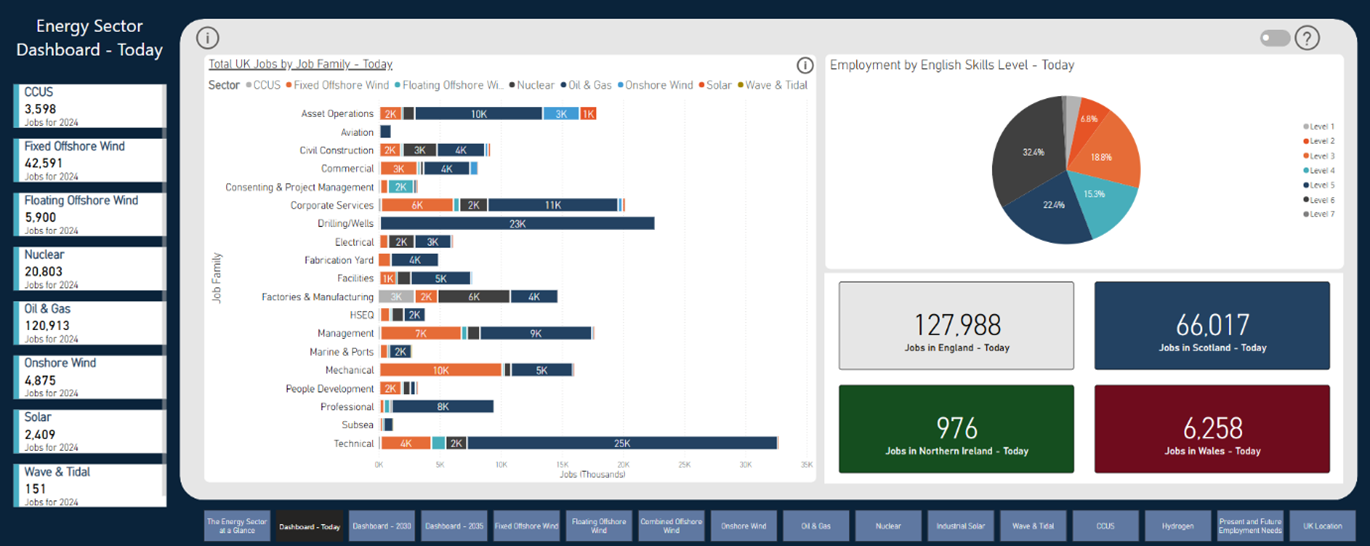
Whether you’re an industry leader, aspiring professional, an experienced recruiter, an academic, an industrial trainer, or simply someone who inspires young people, the ESIH platform provides tailored data insights to help you navigate the evolving human capital landscape, today and in the future.
The ESIH has been built by the Opergy Group of Companies, sponsored and backed by industry leading organisations OPITO and The ECITB and driven by the need for the latest cross sector data.
Go to www.energyskillshub.co.uk and find out for yourself the volume of opportunities available in the energy industry.